


So much of our lives revolves around more. More content, more clothes, more news, more music, more gossip, more work, more money, more more. Everything we do is about accumulating, and we love it.
But when more is the goal, it is quite literally never-ending. An exhaustive cycle painted as a desirable trait—to create, to tastemake, to add to the conversation. We've even named it: '____–maxxing.' Our cultural obsession with optimizing, amassing, and general addition has become its own genre. More isn't just a default; it's part of how we define ourselves.
Absence, now, becomes an interesting counterpoint. It's often read as a negative, but in strategy, it's everything. What we're not hearing, what we're not seeing—where there's nothing, there's an opening. A white space, a place to bring something into. Absence is the golden opportunity, the thing we work so hard to find, and once we do, we tend it like a garden.
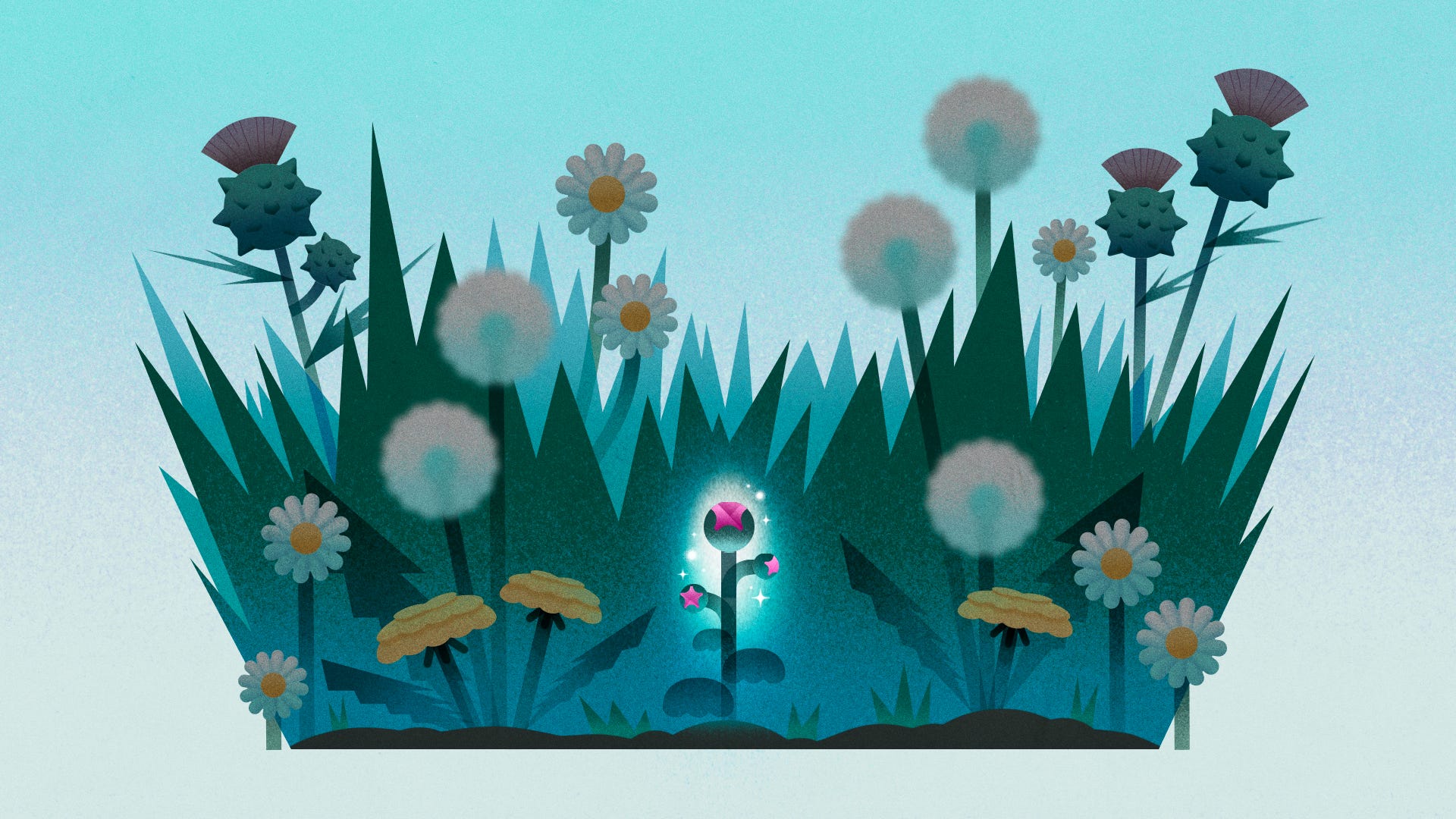
Take the Cash App evergreen design system. The brand itself is a wild collage of cultural artifacts, unique in its landscape precisely for its maximalist, additive qualities. But to refine it into something that could last, we needed to strip out the excess—distilling it down to its core tenets: its signature color, its inherent momentum, its mixed treatment of 2D and 3D objects, its intentional composition. Once we pruned the brand, we could clearly see it for what it was, and from there, begin building it back up—adding and taking away, adding and taking away, until it could live, breathe, and grow on its own. Not by forcing a way in, but by identifying what was already there—that special seed at the core—and tenderly planting it somewhere with room to grow.
That instinct—knowing what to keep, what to cut—isn't just innate. As writer and editor Aliza Abarbanel puts it, "your gut isn't coming from nowhere. It's coming from all of your experience and the lessons you've learned along the way." Good curation is, ironically, accumulated. It's an ongoing practice, not a one-time edit.
And it's not a new idea. Curation has been a design tenet forever. What makes it feel almost novel is the world we're living in—blurry, oversaturated, relentless. The idea of less has gone through many iterations—Marie Kondo and her predecessors included—but it's always been clouded, ironically, by more. Less became a brand. Minimalism became an aesthetic (Love Story and Sarah Pigeon took the West Village girls by storm), and then it became content to post and repost.
Which is part of why curation is so hard to sustain. It isn't just a discipline—it's restraint, and restraint is discipline. It takes willpower to choose, to refine, to kill your darlings. It's easier not to choose. It's easier to add. And often, we lack the discipline to remove something interesting in the service of something exceptional.
The practice of omitting means having to say no. To turn something down, to pick one thing to uphold over another. For humans trained to strive for more, that's incredibly hard. Instagram stories, sample sales, Pop Mart—all designed to make us jump at excess. Take more before it goes away. Our scarcity mindset trains us to grab, and the FOMO industrial complex is counting on it.
The people actually doing it well know it's a project, not a posture. As Jared Blake of Lichen NYC puts it, "Every year we're just like, 'you know what? This is out.'" Not a rebrand—a quiet, ongoing reckoning. "We spend a lot of time responding to what people are asking and looking for." Because often, what's being omitted is valid, interesting, totally appropriate—but does it make sense right now? "Post-COVID, things that used to be in offices are in homes. Things that used to be called filing cabinets are now called USMs. It's changed. And we just try to stay empathetic to those changes and ears to the ground."
Noticing not just what works, but why something doesn’t—that’s where the real practice lives. Curation isn’t taking away. It’s leaving only what belongs.
Our real power lies in the edit. Saying no is the strategy. We tend to think of creation as the most lofty, most labor-intensive, most valuable thing a person can do. But curation, subtraction, omission—that’s really what moves the needle.
This piece stems from “Curation As Discipline: A Conversation on Creative Judgment,” a fireside chat hosted by Asia Hunt at BUCK’s New York studio.